
Will Google Suspend Your Ads Account for Using AI?
A viral LinkedIn post warns: connect Claude Code to your ad account and you lose it. I build exactly these connections for a living, so I traced the story back to its source.
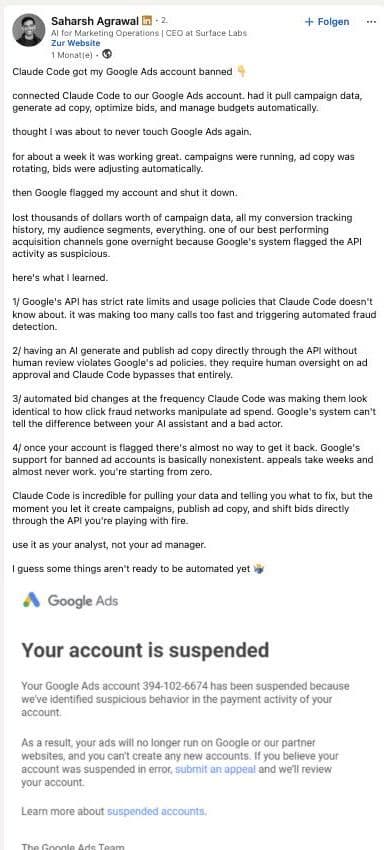
The post from June 22, 2026, screenshot taken July 30, 2026.
"Claude Code got my Google Ads account banned." That is the first line of a LinkedIn post that collected over 1,200 reactions in June. The story inside: Claude Code connected to a Google Ads account, everything ran for a week, then came the suspension. Years of campaign data lost, conversion history gone, appeals pointless. The sender's moral: use AI as an analyst and keep it away from your account.
The post spawned copies, vendors warned their audiences, and in the comment sections media buyers asked whether they should shut down their setups. Internally, the question reached us in a different form: is automated marketing dead?
I checked the story. It does not survive the check.
The paper trail
The June post has two older versions, both from the same sender. On March 25, the same story appeared on LinkedIn with Meta instead of Google (archived). In April, the Meta version followed on Reddit. In June came the Google version that went viral.
Put the Meta and the Google versions side by side and a template with swapped nouns appears:
- API accusation: "too many calls too fast" in the Meta version, word for word the same in the Google version.
- What the AI published: creatives without review (Meta version), ad copy without review (Google version).
- What fraud detection saw: budget changes like "bot networks" (Meta), bid changes like "click fraud networks" (Google).
- Closing line: "use it as your analyst, not your ad manager", word for word the same in both versions.
Both versions tell a first-person story about losing "thousands of dollars worth of campaign data". Once it supposedly happened to a Meta account, once to a Google account, 89 days apart, in identical wording.
The post offers a screenshot of the suspension notice as proof. The stated reason: "suspicious behavior in the payment activity of your account". That describes a payment suspension.
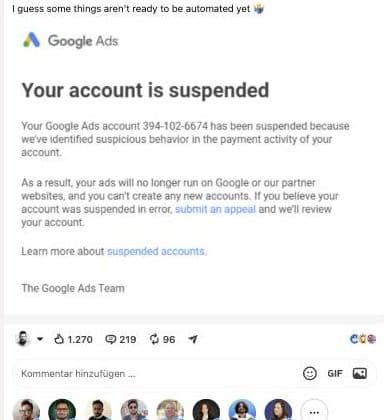
The "proof image" from the post: the stated suspension reason is payment activity, with the reaction row of 1,270 likes below.
A commenter under the post wrote that the image comes from a public Google support thread from 2021 (archived), years before Claude existed. The thread is still online.

The comment under the post, with a link to the support thread.
The copies carried the template forward. Two days after the Google post, a growth manager retold the same story as his own experience, with the same suspension image, account number smudged. A week later, the CEO of an ads management service turned it into a sales pitch, same image again, account number now retouched away. In his comment section, PPC veterans recognized the template as an ordinary payment profile suspension. One wrote that in twenty years he had seen ad accounts die over ad fraud and payment problems, none over API usage.
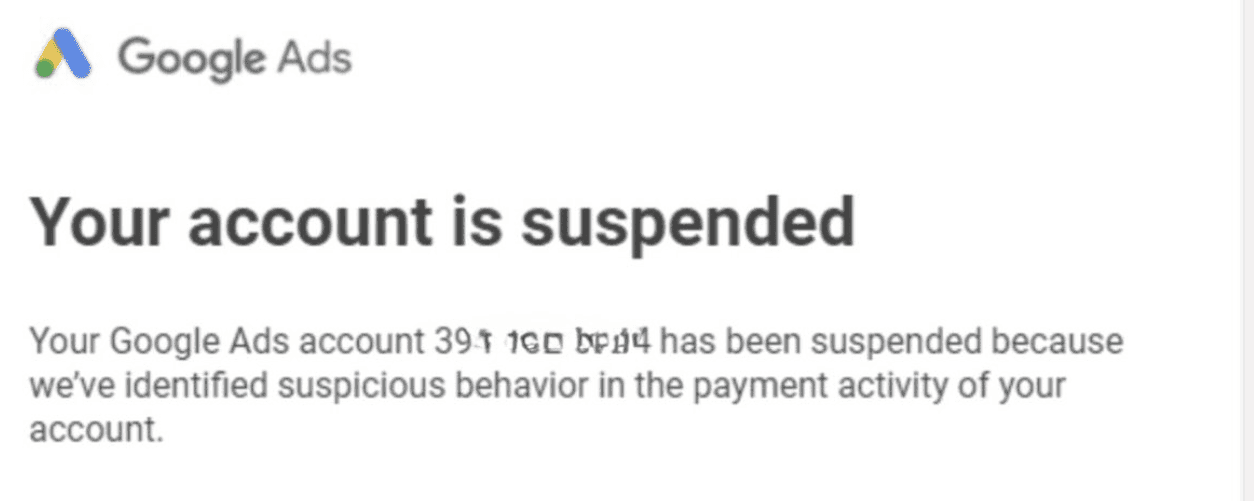
Zoom on the first copy's suspension image: same template, same payment wording, the account number visibly smudged.
I then searched for a single verifiable, named case of a suspension caused by MCP or API usage. I found none. The warning blogs from Supermetrics to HyperFX cite each other and all end at the same anonymous anecdotes. The only source with numbers of its own says the opposite: the agency Zentric documented 1,279 operations via Claude Code against the Meta API, with no suspension and no warning.
The platforms themselves contradict the story
The strongest contradiction comes from Google and Meta directly. Google announced its own open-source Ads MCP server in October 2025, deliberately read-only. The panic wave ran almost a year after Google had opened the official path. Meta launched its own "Ads AI Connectors" on April 29, 2026, lists Claude Code as a supported client in its help center, and added governance rules for agents in July, including server-enforced budget caps. The viral post warns against something the platform documentation provides a manual for. A platform that wanted to suspend accounts for AI access would not build that access itself and equip it with controls.
For honest context: these official servers prove the permitted path, and as marketing tools they are deliberately narrow. Google's server only reads, each one covers a single platform, and setup, developer access, and guardrails remain your job.
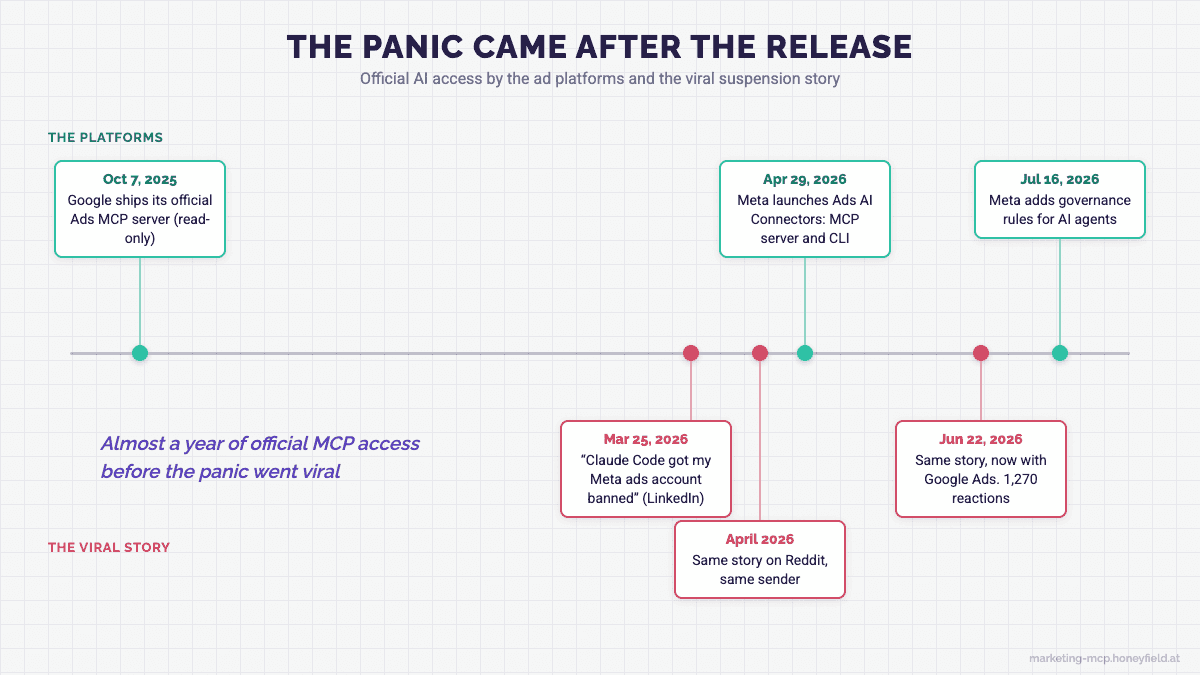
The timeline shows both tracks: the platforms' official AI access on top, the story below.
What is actually risky
Part of the risk is real. You have to separate the layers the viral post mixes up.
Rate limits do not suspend accounts. Query Google's Ads API too fast and you get an error back (RESOURCE_TEMPORARILY_EXHAUSTED), wait briefly, try again. Google documents retry recommendations for this, and no penalty.
API violations hit the developer access. Google's sanctions ladder for API policy violations: warning, fees, access downgrade, in the extreme case termination of the developer token. Google suspends the ad account for ad and content violations, with a strike system and at least seven days advance warning, except for egregious cases like malware.
A human review requirement for API-published ads does not exist in Google's API policy. Creating ads programmatically is what the Ads API is for, tools like Smartly or Optmyzr have done it at industrial scale for years. The "Circumventing Systems" policy such warnings like to cite consists of two sentences. The words API, automation, and scraping do not appear in it.
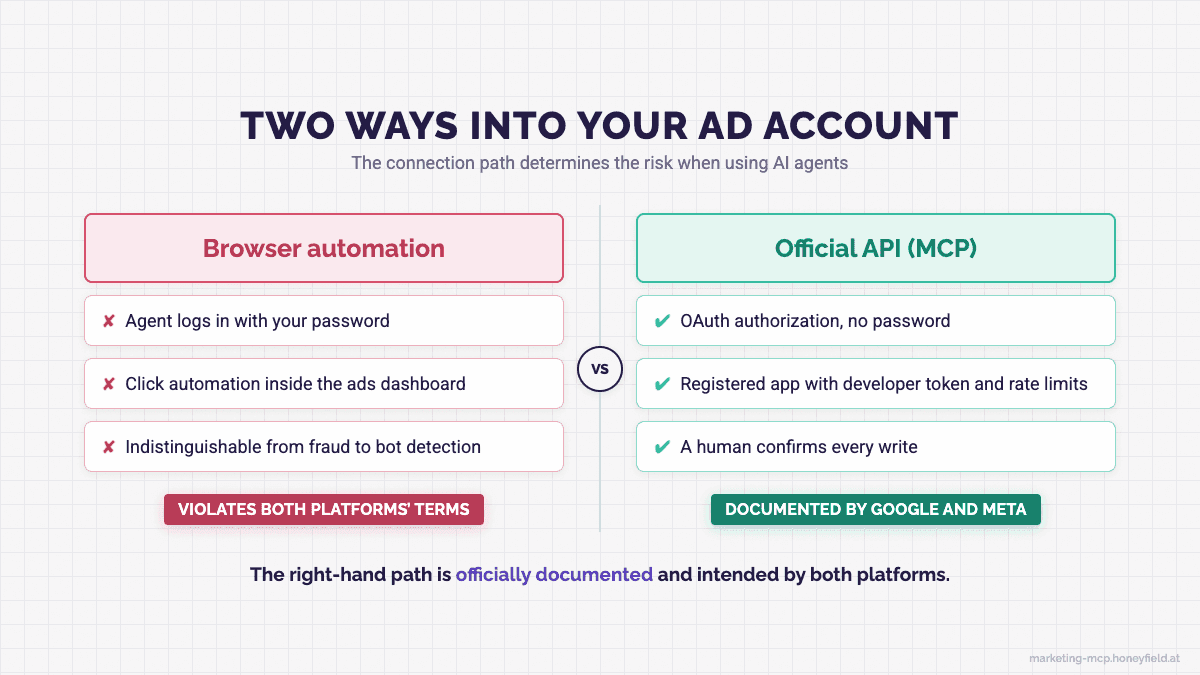
It gets risky with browser automation. An agent that logs into the dashboard and clicks around violates the terms of both platforms. Google's Ads terms prohibit automated data extraction except through expressly permitted paths, Meta's terms prohibit automated access without prior permission. The official API path is that permission. A dashboard bot never has it. Add an engineering truth that has nothing to do with suspensions: an agent with unthrottled write access to a live ad account is a design flaw.
The difference the viral posts blur: dashboard automation violates the terms, the API path is the documented one.
For perspective on the suspension fear, the base rate helps. Google suspended 39.2 million advertiser accounts in 2024 alone, in 2021 it was 5.6 million. False-suspension waves have been documented for years, long before MCP. In late 2025, Google announced it had reduced wrongful suspensions by over 80 percent. Mysterious account suspensions have accompanied these platforms forever. Google's enforcement itself runs on machine learning models, by now including LLMs. The suspensions that supposedly punish AI usage are pronounced by an AI.
How to spot a risky connector
Five questions before you let a tool near your ad account:
- Does it authenticate via OAuth? A tool that wants your password fails.
- Does it speak the official API? Remote-controlled browsers and dashboards fail.
- Does it run as a registered application with a developer token or reviewed app access?
- Does it respect rate limits with clean backoff?
- Does a human confirm every write before it goes live?
Five times yes means the setup matches what the platforms themselves document. Every no is a reason not to connect the tool.
How we build it
This is our product category, so here it is in concrete terms: our Marketing MCP connects Claude through the official APIs to the channels that belong together in daily marketing work. Google Ads, GA4, Search Console, and Business Profile hang on a single Google authorization, Meta, LinkedIn, and the CMS join in the same workspace. OAuth instead of passwords, registered API access, rate limits. Reading is the default. Write operations are created by the agent as proposals and executed after your confirmation. This architecture was set before the suspension debate, for the simple reason that ad budgets deserve confirmations. The wave changed nothing about it, it only showed why it is built this way.
What remains
The story behind the wave is a thrice-recycled anecdote with a screenshot that shows something other than claimed. Nobody in the entire chain delivered a verifiable suspension case caused by official API usage. In the same period, the platforms built official AI access, documented it, and equipped it with controls. Take the documented path and you can connect Claude to your ad account today and sleep well.

AI Engineer & Product Manager
Philipp builds AI products at Honeyfield such as the Marketing MCP, from product idea to tool design for agents. His focus is context engineering: making agents work reliably with real marketing data.
LinkedIn